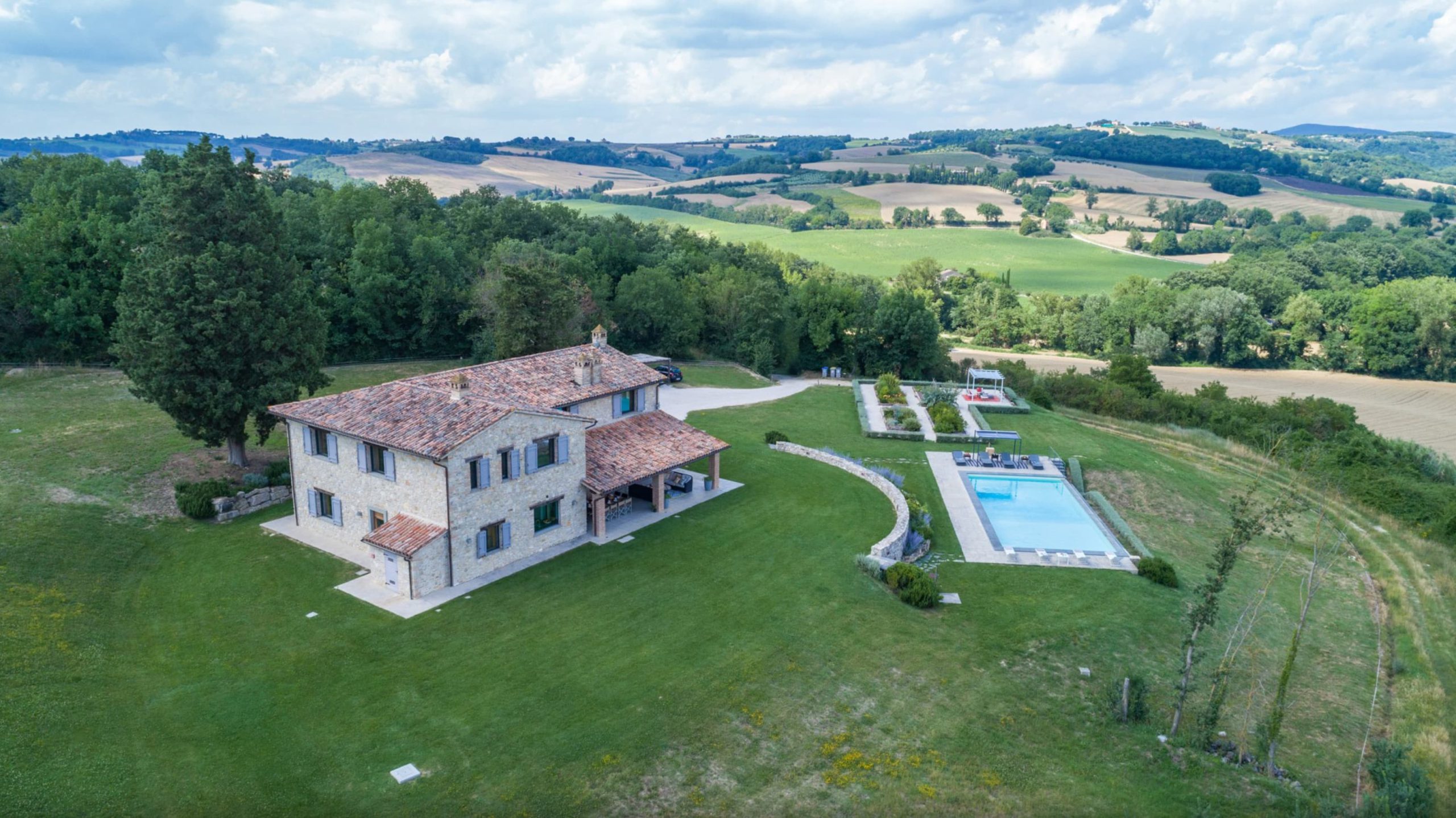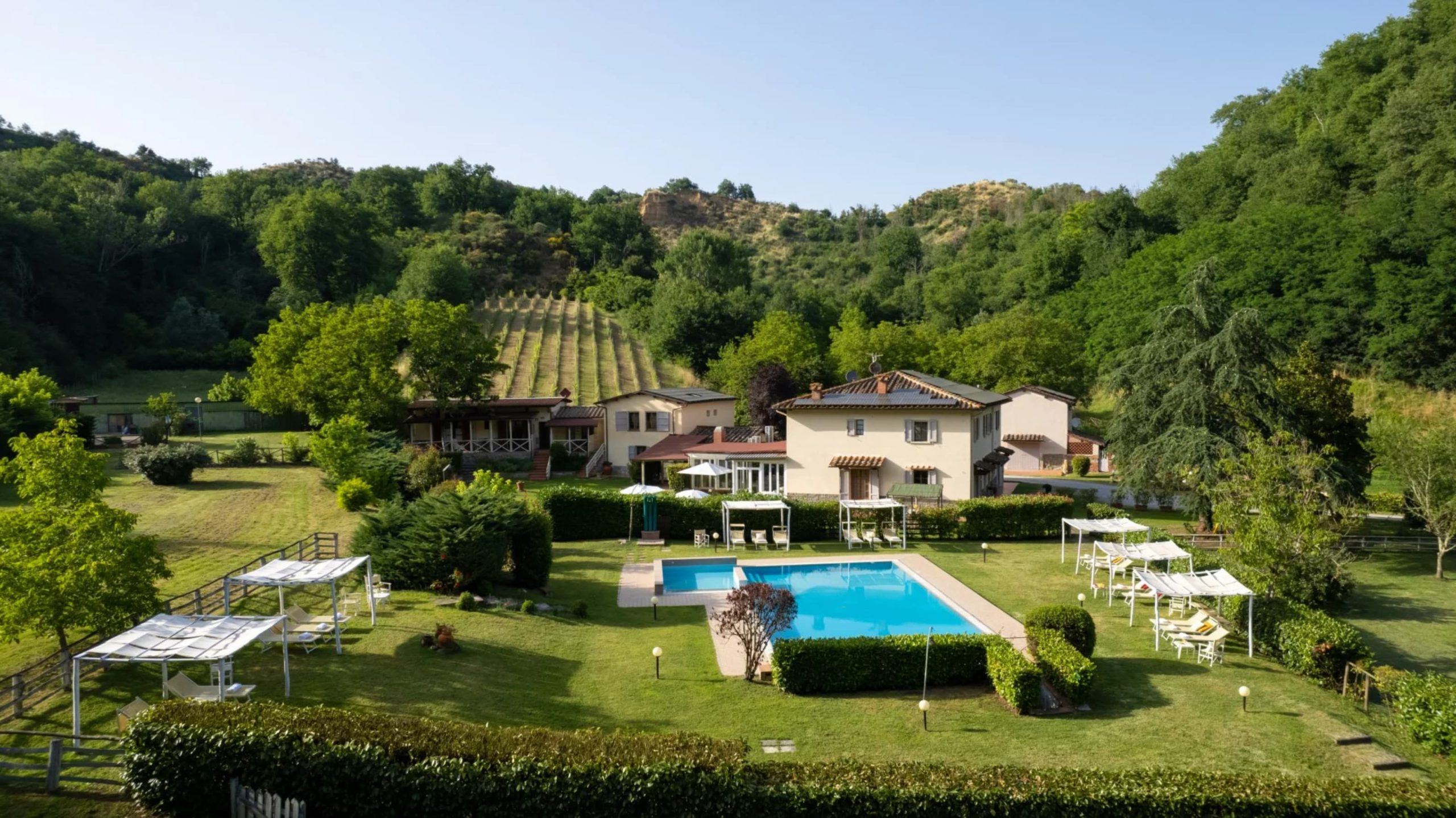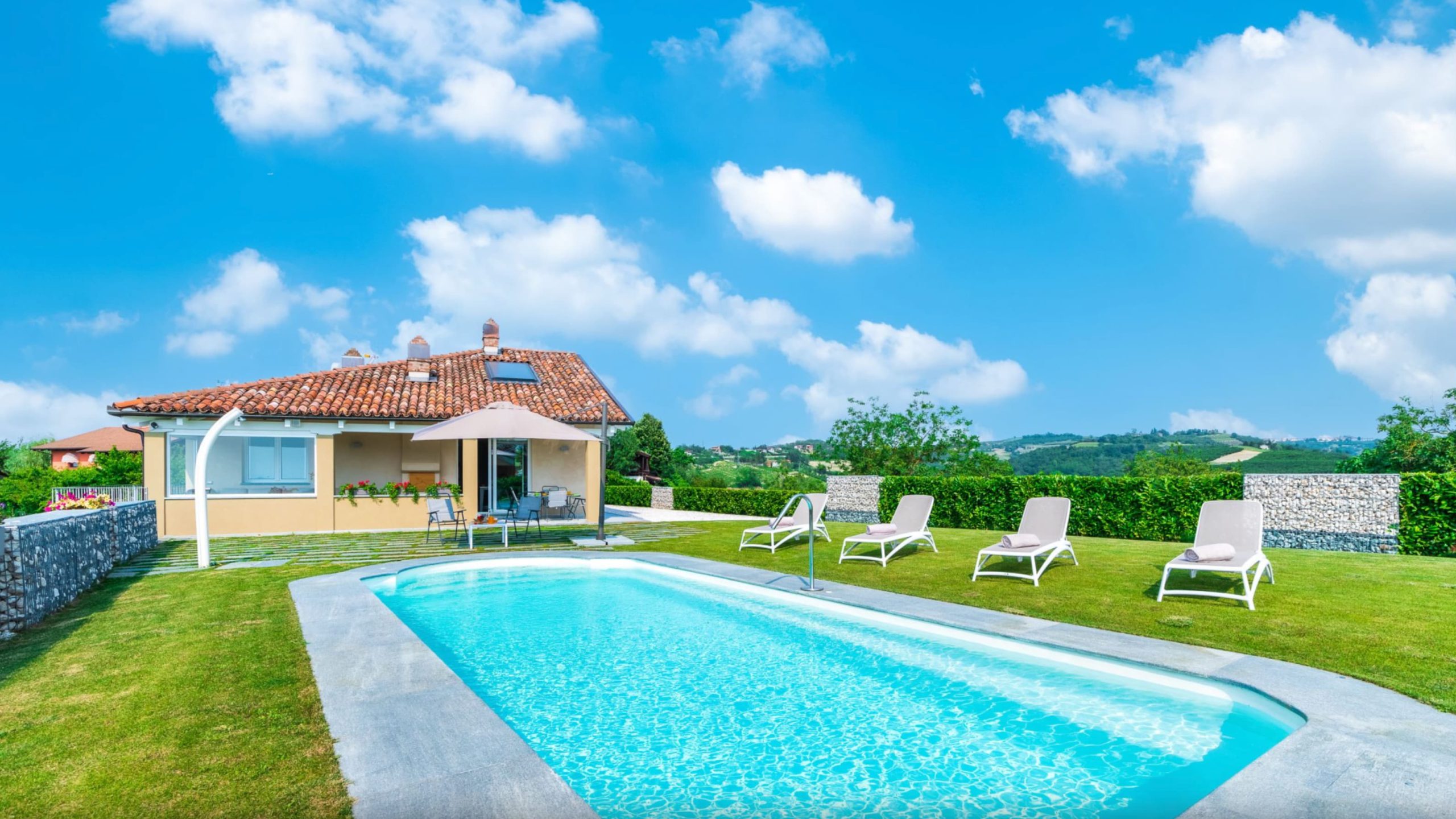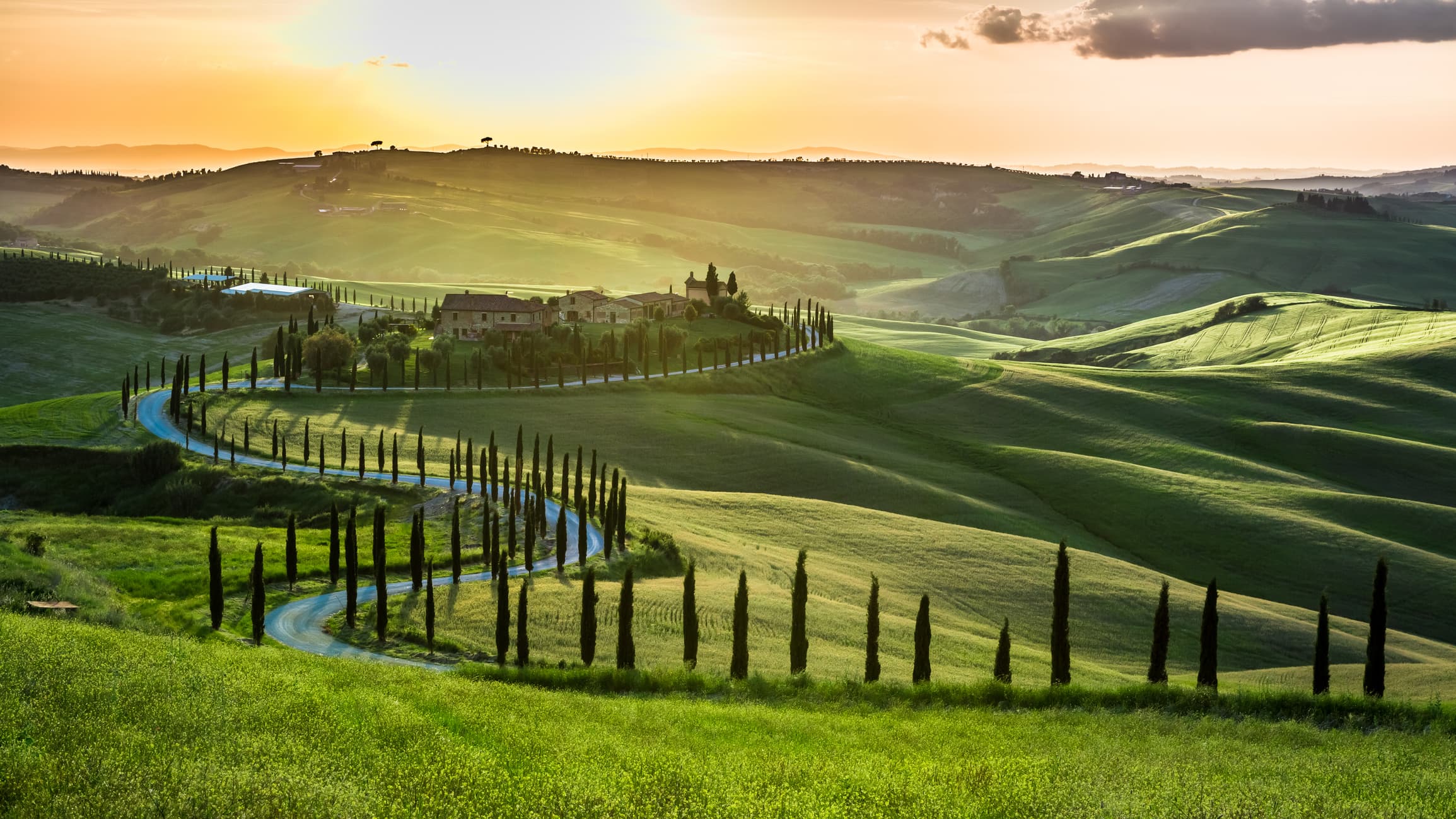
Umbria is a small landlocked region in the exact centre of Italy, bordered by Tuscany, Le Marche and Lazio. It is the only Italian region with neither a coastline nor a frontier with another country, and the only one on the peninsula that no sea touches. It covers roughly 8,460 square kilometres, has around 850,000 inhabitants and just 92 municipalities — fewer than any other ordinary-statute region. Its capital is Perugia. It is called the green heart of Italy because it is almost entirely hill and mountain, and because that landscape has stayed largely intact.
Where it is, and what that means
Umbria sits between Tuscany to the west and north, Le Marche to the east and north-east, and Lazio to the south. Rome is a couple of hours away, Florence a little more. This central position explains a great deal about the region: it was never a place people passed through on the way to somewhere else, and it never developed a coastal tourism economy.
The consequence is a region that has stayed itself. There is no seafront strip, no cluster of resort towns, and no single season in which everything happens at once. What there is instead is a landscape of hills, valleys and hill towns that has not been substantially rearranged for visitors.
Why “the green heart”
The nickname is literal rather than promotional. Umbria is a region of hills and mountains with very little flat land — the plains are mostly the floors of intermontane basins and river valleys. Woodland, olive terraces and pasture cover most of it, and the highest ground, in the south-east towards the Sibillini mountains, rises past 2,400 metres.
The Tiber rises just outside the region and runs the length of it before reaching Rome, and the valleys it and its tributaries have carved are where the towns and the farming sit. In spring the interior is green in a way that lasts only a few weeks in much of central Italy; in Umbria it is the defining characteristic.
Water in a region with no sea
For a landlocked region Umbria is unusually rich in water, and this is one of the things that surprises first-time visitors.
Lake Trasimeno covers about 128 square kilometres and is the largest lake in peninsular Italy and the fourth largest in the country. It is also remarkably shallow — an average depth of under seven metres — which is why it warms quickly and why the light on it is the pale silver that Byron noticed. Castiglione del Lago and Passignano sit on its shores, and three islands sit in it.
The Cascata delle Marmore is an artificial waterfall of Roman origin, with a total drop of around 165 metres, created by diverting the Velino into the Nera. It still runs to a schedule: the gates open at set times, and the fall goes from a trickle to full flow in front of you. It is one of the few landscape features in Italy that has an opening timetable.
Nearby is Lake Piediluco, small, deep and ringed by wooded hills, and across the region the springs of the Clitunno — a small, clear source that Roman writers described and that Corot and Byron came to see.
The towns
Umbria is a region of towns rather than of cities, and most of them sit on hills.
Perugia is the capital: Etruscan foundations, a medieval centre on a ridge, two universities and a student population that keeps it awake outside the tourist season.
Assisi is the best known. The Basilica of San Francesco and the other Franciscan sites in the town were inscribed as a UNESCO World Heritage Site in 2000. The basilica was begun in 1228, two years after Francis died, and consists of two superimposed churches — the Lower Church completed around 1230, the Upper Church consecrated in 1253 — frescoed by Cimabue, Giotto and Simone Martini. It is one of the places where the history of Italian painting was written.
Orvieto stands on a plug of volcanic rock above the plain, with a striped cathedral and an Etruscan underworld of tunnels and wells beneath it.
Spoleto, Todi, Gubbio, Spello, Montefalco, Bevagna, Norcia — each is a half-day, and the drives between them are short. Gubbio holds the Tavole Eugubine, seven bronze tablets from the third to first centuries BC carrying the longest surviving text in a pre-Latin Italic language, and its Festa dei Ceri is important enough that the three ceri appear on the regional coat of arms.
Food and wine
Umbrian cooking is inland cooking: pork, game, pulses, bread, oil and truffle. It is plainer than Tuscan food and, for many visitors, better.
Truffle is the signature. Black truffle is found around Norcia, Spoleto and the Valnerina, and the season runs through the winter. Norcia is also the origin of the Italian word for a pork butcher — norcino — which tells you what the town has been doing for a very long time.
Lentils from Castelluccio grow on the Piano Grande, a high plain in the Sibillini. Between late spring and early summer that plain flowers, and the fioritura draws people from across Italy.
Wine means principally Sagrantino from Montefalco — a dense, tannic red made from a grape grown almost nowhere else — and the white of Orvieto. Olive oil from the hills around Trevi and Spoleto is among the best in the country.
What people come for
- Walking and slow travel. The Via di Francesco and other routes cross the region on foot, linking Assisi to the hermitages and the woods around them.
- Art and architecture. Assisi and Orvieto are the headline, but Perugia, Spoleto and Montefalco all hold work that would be a major attraction in a less crowded field.
- Food and wine. Truffle in winter, oil in late autumn, Sagrantino all year.
- Quiet. The most common reason people return. Umbria has the landscape and the towns of a far busier region and a fraction of the traffic.
Umbria or Tuscany?
It is the question almost everyone asks, because the two regions share a border, a landscape type and a reputation. The short version: Tuscany is larger, more famous and more organised for visitors; Umbria is smaller, quieter and closer to how both regions looked thirty years ago. Neither is better. They suit different trips, and the choice deserves more space than a paragraph.
When to go
Umbria has no beach season, so its calendar is not the coastal one. May and June are the peak of the landscape — green hills, long light, the Castelluccio flowering towards the end of that window. September and October bring the grape harvest, then the olives, and the light turns. Winter is truffle season and the towns belong to the people who live in them. July and August are hot in the valleys and pleasant at altitude, and considerably less crowded than the Tuscan or coastal equivalents.
Frequently asked questions
Where is Umbria?
In the centre of Italy, bordered by Tuscany to the west and north, Le Marche to the east and north-east, and Lazio to the south. It is the only Italian region with neither a coastline nor an international border.
What is Umbria known for?
Assisi and Saint Francis, hill towns such as Orvieto, Spoleto, Todi and Gubbio, Lake Trasimeno, the Cascata delle Marmore, black truffle around Norcia, Sagrantino wine from Montefalco, and a landscape of hills and woodland that gives it the name green heart of Italy.
Is Umbria worth visiting instead of Tuscany?
For visitors who want the same landscape and towns with fewer people and shorter queues, yes. Tuscany is larger and better known; Umbria is quieter and less organised around tourism, which is precisely what many people are looking for.
How big is Umbria and how do you get around?
About 8,460 square kilometres, with 92 municipalities and around 850,000 inhabitants. Distances between towns are short but the roads are winding, so a car is the practical way to travel; the nearest major airports are Perugia, Rome and Florence.
When is the best time to visit Umbria?
May and June for the landscape at its greenest, September and October for the harvest and the light. Winter is the truffle season and the quietest time of year.